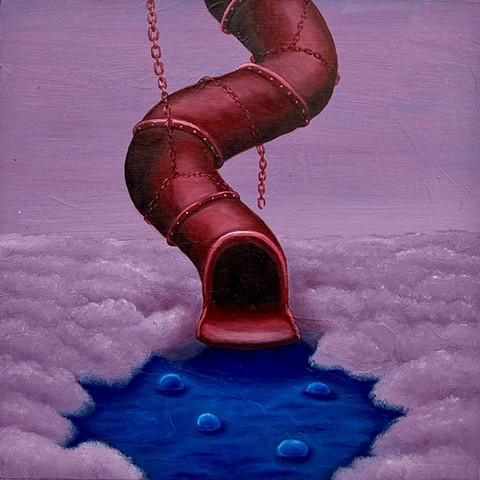
My body of work is an exploration of the imagery generated in dreams from the subconscious. Through the use of excerpts from a dream log, these pieces place images seen during a night’s sleep for the viewer to immerse themselves in. The dream log serves to record dreams after they have concluded, and allow for recalling the memory of its occurrence. These images serve to tell a story from the subconscious and evoke the emotion that is associated with the dream experience. Objects representative of the dreamworld are placed in a seemingly infinite cloudscape, tinted in a calming light lavender. Seemingly ordinary objects appear in a cool red or a dark blue, utilizing color psychology to give the appearance of a calm that turns to unease the longer the viewer observes it. Darker purple dreamscapes give the viewer a peek into the unconscious mind, where memories and emotions are stored for later use in generating a dream. There are four groupings that panels are sorted by; Dream Summoning, Dream Sequences, Recurring Symbols, and Visual Rests. When exhibited, the groupings remain together, with the exception of the visual rests, which are dispersed between groupings to provide a natural pause between viewing.
The origin of this body of work started with the first dreamscape I created, which took a much different form. Antiquity, a piece representing a particularly impactful dream combined portraiture and surreal landscape. The dream featured an infinite sea of red clouds that I laid upon during the dream. The painting depicted myself in the dreamworld during that specific moment. After an exploration of other works, I returned to creating dreamscapes because I felt compelled to do so. It was something planned for a long time, but the approach was unclear until now. Shifting from portraiture to creating the dreamscape felt natural. Seeing that the excerpts logged in the dream journal were descriptive enough to build the scene, referencing them for new paintings seemed logical. The dilemma reached was that the scenes made were not evident dreamscapes, as they filled the entire frame and used darker or unusual color. The works, then, shifted to the use of clouds in the foreground as a stage for the next work.
The use of the clouds directly relates to Antiquity, but swapped from red to the shade of lavender that matches my childhood bedroom walls. Following an analogous color scheme, alizarin crimson and prussian blue were introduced into the limited color palette. For cohesion purposes and the emphasis on the surreal nature, no other colors were utilized and the palette stayed limited throughout the body of work. This work allows the viewer to experience dreams with me, seeing small parts but most importantly, feeling the emotions that I had felt. It served as a means for me to process unresolved trauma, reflected in dreams as found in supporting psychological research, through painting as a therapeutic tool.